


Did you know the FSC publishes fold out charts and guides? Find out more.
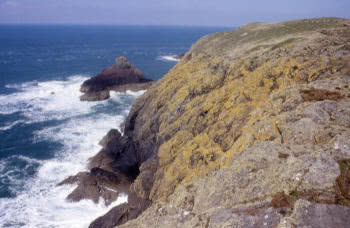
Extensive splash zone on Skomer Island, facing west, B.E.S. 1 (see Balltantine Exposure Scale)
For our purposes we are defining this zone as the bit of shore above the highest tides (extreme high water spring tides (EHWS)) and below the start of truly terrestrial vegetation. The upper limit of the splash zone cannot be identified precisely because it depends on the size of the waves causing the splash and these are different on every shore and every day has different wave conditions. On exposed shores the splash zone may reach far above the height of the EHWS because the waves are usually large and splash very high up. See Skomer above. On a typical exposed shore around Dale you'd expect a zone of anything from 5 to 30 metres in height depending on the height of the cliffs.
Lichens are the dominant organisms in the splash zone. They are colonisers of bare rock and are slow growing but long lived. As they grow the action of acids and expansion of their cells can help to break up the rock into tiny fragments to produce a raw soil. This may then be colonised by mosses and as humus collects in crevices, by flowering plants able to tolerate the high salt content eg. thrift (Armeria maritima).
Lichens are made up from two different organisms, a fungus
and an alga, together they form a symbiotic, mutualistic relationship.
Separately, they would require moist, sheltered conditions, together
they survive in very hostile places.
The fungal partner makes up about 80% of the lichen. The algal
partner is almost always either a green alga (Chlorophyta) or
a blue-green alga (Cyanobacteria). Some grow particularly well
where there is a high nitrogen content eg. from sea bird
droppings. Xanthoria
may be prolific for this reason; it releases spores continually
through the year. Spores consist of an algal cell encased in strands
of the fungus. The orange (eg. Caloplaca)
and grey lichens (eg. Ochrolechia)
in this zone are slow growing and therefore intolerant of grazing
by marine snails. Verrucaria
found further down the shore is faster growing and more resistant
to grazing. These salt-tolerant lichens form an important community
between the inter-tidal zone and the truly terrestrial communities
on the cliff tops. Lichens are very susceptible to pollution and
can be used as indicators of sulphur dioxide in the air. Splash
zone lichens are killed by oil pollution and some of the detergents
used to disperse spills.
The flowering plants surviving here depend on their ability to
cope with the salt and desiccation, coupled with the almost total
lack of soil. On exposed shores condition are too extreme for
flowering plants to cope with except for at the top of the zone.
Thrift deals with all of
this and grazing. Sea plantain (Plantago
maritima) also grows here both are members of tundra communities.
To avoid water loss leaves of these plants are narrow and succulent.
This will
reduce the surface area. Around the stomata of the leaves may
be a dense cover of hairs, helping to retain moisture.
Few marine animals survive in the splash zone on exposed shores. The rough periwinkle (Littorina saxatilis agg.) and the small periwinkle (Melarhaphe neritoides) are two that can. They can graze on lichens, have protective shells and all manner of other attributes that allow them to survive here.
Compare this zone (splash zone) with one from and sheltered shore.
Looking for a next step?
The FSC offers a range of publications, courses for schools and colleges and courses for adults, families and professionals that relate to the seashore environment. Why not find
out more about the FSC?

FEEDBACK
Do you have any questions?
Copyright © 2008 Field Studies Council

Creative Commons Attribution-Noncommercial-No Derivative Works 3.0 Licence .
Site Statistics by Opentracker


